Unconscious Flows
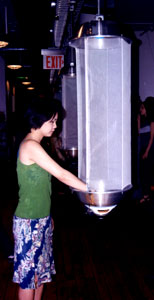
unconscious flows, a public art installation designed along with Christina Wong, allows multiple users to communicate by remotely sensing the presence of others through four hanging water capsules.
user experience
what is happening here?
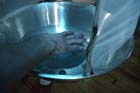
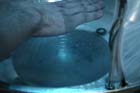
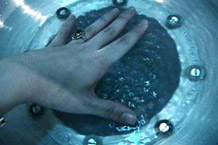
As a user looks into a capsule or places a hand over the water, photocells alter the amplitude, rhythm, and tempo of low-frequency sounds. The vibrations from these sounds create concentric patterns upon the water's surface which change depending on the proximity of the user, the number of participants, and the length of each interaction.
Meanwhile, speakers within the top of each capsule play music that is generated in real-time. Information gathered from the user's input is manipulated within the computer to create the specific tones, amplitudes, and rhythms of gentle chimes and bells.
Communicating through abstract forms such as music, vibration, and touch, participants are challenged to examine the ways in which their actions are translated to those around them.
technology
what are we doing?
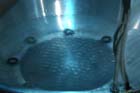
As designers, we focused on creating an aesthetically minimalist project working much of the technology into the actual design. Using photocells mounted beneath plexiglass sheets in the water, we are able to sense the presence of a user. By lighting each capsule from within, we not only illuminate the project but we create a constant source of light from which we can measure shadow. In this way, we are able to calculate the distance of a user's hand from the surface of the water. This information is sent to a microprocessor (which interfaces with a G3 mac) that feeds the data into a MAX application where it is analyzed and used to control variables that directly affect the project's output.
Using sound as a model of communication, low frequencies are played through subwoofers mounted in each capsule's base in order to create patterns upon the water. By altering the amplitude, rhythm, and tempo of these sounds, a variety of visual effects can be achieved. These range from the subtle, crystalline, concentric circles slowly emanating from the pool's center to the extreme splashes of water rushing up to meet a user's hand.
The soundscape which plays from the inside of each capsule is also generated in real-time according to each user's interaction with the installation. The proximity of the user's hand to the surface of water (as well as the number of users) directly affects the volume of the soundscape, the notes being played, and the rhythm of the chimes. In this way, each of the capsules may be used as a single instrument which is part of a larger whole. The generative soundscape heard in each of these capsules is the same while the individual voices which make up the music are controlled by each station in the installation.