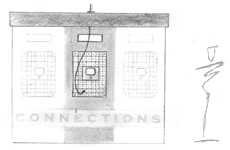
Connections
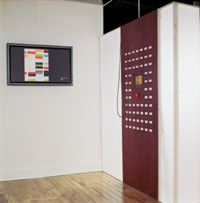
(a design prototype for the Whitney Museum of American Art - created by jon alpert, eric green, betsy seder, and victoria westhead)
Connections offers a way for visitors to explore, in an interactive environment, some of the many works that a museum owns, but is unable to display. It gives them the opportunity to participate in the selection of artworks that will be shown in a gallery of the museum through both a physical installation, and virtually through the museum's website. It begins to examine the relationship between virtual and physical spaces and extends the limitations of the museum's physical facilities.
user experience
Visitors entering the Connections gallery are immediately drawn to the colorful projections of artwork that illuminate three of the walls. Moving through the space, they pause to watch as the images change over time. Finally, curious about what's happening, they head to the far wall, where others are putting plugs into a grid of sockets. As the visitors take turns at the wall, they are fascinated by the descriptions of artworks before them and excited to watch as their selections turn into projections on the gallery wall.
design description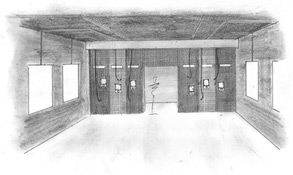
Connections will be installed in a gallery of the museum. One wall of the gallery will be laid out with a grid of sockets and have several cables hanging down. Both the number of cables and sockets will be determined by the size of the gallery space.
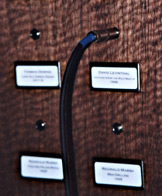
Each cable will correspond to a portion of wall in the gallery upon which a digital representation of the artwork chosen with the cable will be displayed. A user is able to explore the museum's collection by plugging the cable into different sockets embedded in the wall. As s/he plugs the cable into a socket, the specific artwork associated with that socket is displayed in a monitor (also part of the wall) along with the work's title and creator. Once the user finds a work of art with which he or she connects, s/he presses a large red 'launch' button which fades this chosen image onto the gallery wall in its original size.
There will be one image per socket, and the selection of artwork and its arrangement within the grid can be made in any way that the museum desires. Titles above each column will give the visitor an idea of the general organizing principal of the images.
Connections is also accessible through the museum's website. Visitors are able to explore the museum's database of images and 'launch' a chosen artwork into the museum. One wall space in the physical gallery will be reserved exclusively for these remotely selected images.
user potential - gallery installation
Each version of Connections offers users a different experience. The physical installation, with its fairly simple interface, provides opportunity for participation in a playful manner. It will allow visitors to explore unseen artwork and make choices about what is on display, personalizing a part of their museum visit. A lone visitor could curate an exhibit by his or herself, but when the museum is crowded, a single person will have access to only one or two cables and may look at the work that others have chosen for inspiration. Possibility exists for visitor interaction and collaboration.
The physical exhibit will be a wonderfully flexible tool for docent tours and school groups. Armed with the map of images, a tour guide can show examples on a variety of topics, changing the art on the wall simply by plugging into different sockets. Unlike the slide show, the art will exist in a physical gallery space all around the audience and groups will be able to participate in the selection of that art. Adults and children alike will be able to work together to create collaborative exhibits and to juxtapose works of art in the exploration of a variety of themes.
Because the images are all drawn from the museum's own database, the exhibit can be altered on a regular basis by changing the artworks available to the audience through the sockets. This flexible design means artworks can be chosen to correspond with current exhibits or any other criteria the museum selects.
conclusion
Participation in either the physical or virtual space gives users a more personalized museum experience. They are given an opportunity to explore their own interests in art, discover new works, artists, ideas and think about how exhibits get put together. The physical installation provides museum visitors with a new and unique art museum experience in which they can make choices about which unseen works are displayed and which works are shown together. Or they can simply watch the gallery space change over time as the artworks shift. The web portion of the project allows the user to spend time with the Whitney's collection and to participate remotely in the choice of a work in the physical space. Connections is not intended to democratize the curatorial process or undervalue the Whitney's educational role; rather it will increase the visitor's understanding of that process.
The cables themselves refer to the wired nature of our current world. Technology has expanded the process of curatorship, providing easier access to the museum's own holdings and a global network of museum holdings.
The juxtaposition between the physical and remote components of the project starts a discussion on the relationship between traditional and new ways of viewing art and making art. The cables allow museum visitors to connect to a collection in a remote and unseen location, as they allow remote and unseen web users to connect to the physical space. They physical space is connected to a virtual space, just as the virtual exploration finds an outlet in the physical gallery space. Connections opens up the museum experience and expands its very definition.
user experience
Visitors entering the Connections gallery are immediately drawn to the colorful projections of artwork that illuminate three of the walls. Moving through the space, they pause to watch as the images change over time. Finally, curious about what's happening, they head to the far wall, where others are putting plugs into a grid of sockets. As the visitors take turns at the wall, they are fascinated by the descriptions of artworks before them and excited to watch as their selections turn into projections on the gallery wall.
design description
Connections will be installed in a gallery of the museum. One wall of the gallery will be laid out with a grid of sockets and have several cables hanging down. Both the number of cables and sockets will be determined by the size of the gallery space.
Each cable will correspond to a portion of wall in the gallery upon which a digital representation of the artwork chosen with the cable will be displayed. A user is able to explore the museum's collection by plugging the cable into different sockets embedded in the wall. As s/he plugs the cable into a socket, the specific artwork associated with that socket is displayed in a monitor (also part of the wall) along with the work's title and creator. Once the user finds a work of art with which he or she connects, s/he presses a large red 'launch' button which fades this chosen image onto the gallery wall in its original size.
There will be one image per socket, and the selection of artwork and its arrangement within the grid can be made in any way that the museum desires. Titles above each column will give the visitor an idea of the general organizing principal of the images.
Connections is also accessible through the museum's website. Visitors are able to explore the museum's database of images and 'launch' a chosen artwork into the museum. One wall space in the physical gallery will be reserved exclusively for these remotely selected images.
user potential - gallery installation
Each version of Connections offers users a different experience. The physical installation, with its fairly simple interface, provides opportunity for participation in a playful manner. It will allow visitors to explore unseen artwork and make choices about what is on display, personalizing a part of their museum visit. A lone visitor could curate an exhibit by his or herself, but when the museum is crowded, a single person will have access to only one or two cables and may look at the work that others have chosen for inspiration. Possibility exists for visitor interaction and collaboration.
The physical exhibit will be a wonderfully flexible tool for docent tours and school groups. Armed with the map of images, a tour guide can show examples on a variety of topics, changing the art on the wall simply by plugging into different sockets. Unlike the slide show, the art will exist in a physical gallery space all around the audience and groups will be able to participate in the selection of that art. Adults and children alike will be able to work together to create collaborative exhibits and to juxtapose works of art in the exploration of a variety of themes.
Because the images are all drawn from the museum's own database, the exhibit can be altered on a regular basis by changing the artworks available to the audience through the sockets. This flexible design means artworks can be chosen to correspond with current exhibits or any other criteria the museum selects.
conclusion
Participation in either the physical or virtual space gives users a more personalized museum experience. They are given an opportunity to explore their own interests in art, discover new works, artists, ideas and think about how exhibits get put together. The physical installation provides museum visitors with a new and unique art museum experience in which they can make choices about which unseen works are displayed and which works are shown together. Or they can simply watch the gallery space change over time as the artworks shift. The web portion of the project allows the user to spend time with the Whitney's collection and to participate remotely in the choice of a work in the physical space. Connections is not intended to democratize the curatorial process or undervalue the Whitney's educational role; rather it will increase the visitor's understanding of that process.
The cables themselves refer to the wired nature of our current world. Technology has expanded the process of curatorship, providing easier access to the museum's own holdings and a global network of museum holdings.
The juxtaposition between the physical and remote components of the project starts a discussion on the relationship between traditional and new ways of viewing art and making art. The cables allow museum visitors to connect to a collection in a remote and unseen location, as they allow remote and unseen web users to connect to the physical space. They physical space is connected to a virtual space, just as the virtual exploration finds an outlet in the physical gallery space. Connections opens up the museum experience and expands its very definition.