Abstract Art
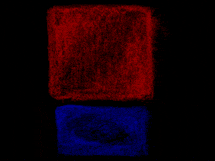 The Abstract Painting Project is a screen-based installation that evolves according to its environment and own life span. Visually experimenting with the traditional elements of painting and abstraction, the work transforms itself according to both linear and cyclical time. Gradually changing its look and meaning, this dynamic painting is a work of art designed for a public space.
Journal Entry One
beginning of project
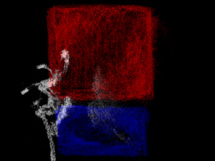
Currently, I am working with the play between abstraction and representation in a project dealing with memory and the creation of visualized mental spaces. Seeing my work as part of a continuum - looking to abstract painting and post-modernism has informed my approach to the project. Using changing surfaces to create depth and the push towards abstraction of form, I hope to explore the differences between the concrete nature of representational narration and abstract notions of visceral connections. Focusing upon color, tempo, relational movement, time, and memory, I move away from recognizable symbolic forms and use the structure of the computer to interpret time, relationships, and memory. Abstracted from representational methods in this way, I hope to explore the way new technology may function within the continuum of various artistic movements. Informed by the theoretical structures of the dadaists, symbolists, cubists, and constructivists, I wish to see how some of the revolutionary concepts that existed pre-computer translate into this relatively young digital space. With new tools available, new art forms can grow from these ideas. This project is an experimentation with the translation of the political, visual, and visceral into a new space which allows new forms of interaction.
Journal Entry Two
on art
No one has figured out the purpose of art yet, and perhaps it will never be discovered. There is meaning in art - but that is not itŐs sole purpose. Art is different because it invokes mental interaction in a space not created by itself.
'i can create nothing, so i am nothing'
It conveys information, but it is not forced. Sometimes, it is even inaccessible (this can be part of the form). It is a process of interacting that occurs outside of the work of art itself. Looking can be interactive as the post-modernists have explored, and art can now look as well. It cannot see, but it can look. This not only gives it a new found theoretical power...but the ability to change depending on what it is given to interact with. Interactive art, whether in the form of installation or object, places the user in a space where the mental and physical converge.
Art possesses the ability to take the spectator/participant fragmentation and create a vibratory energy which fuses the two back into one. Ritual is able to accomplish this as well, and by engaging the user viscerally and mentally, it is able to create a more full interaction.
This energy is part of the thought process.
in 1913 he placed a bicycle wheel upside down on a stool; singled out for contemplation in isolation from its normal context and purpose, it seemed strangely enigmatic, especially when the wheel turned pointlessly. -- rubin on duchampWhat art can accomplish is not the pointlessness that rubin refers to when discussing dadaism, but the contemplation of our worlds. Art is needed to balance out interactions with set goals so that those goals can be constantly reevaluated. In a culture of speed, we run the risk of loosing consciousness due to sheer information overload. Through contemplation, we are able to keep ourselves in a system where we can understand our choices and actions.